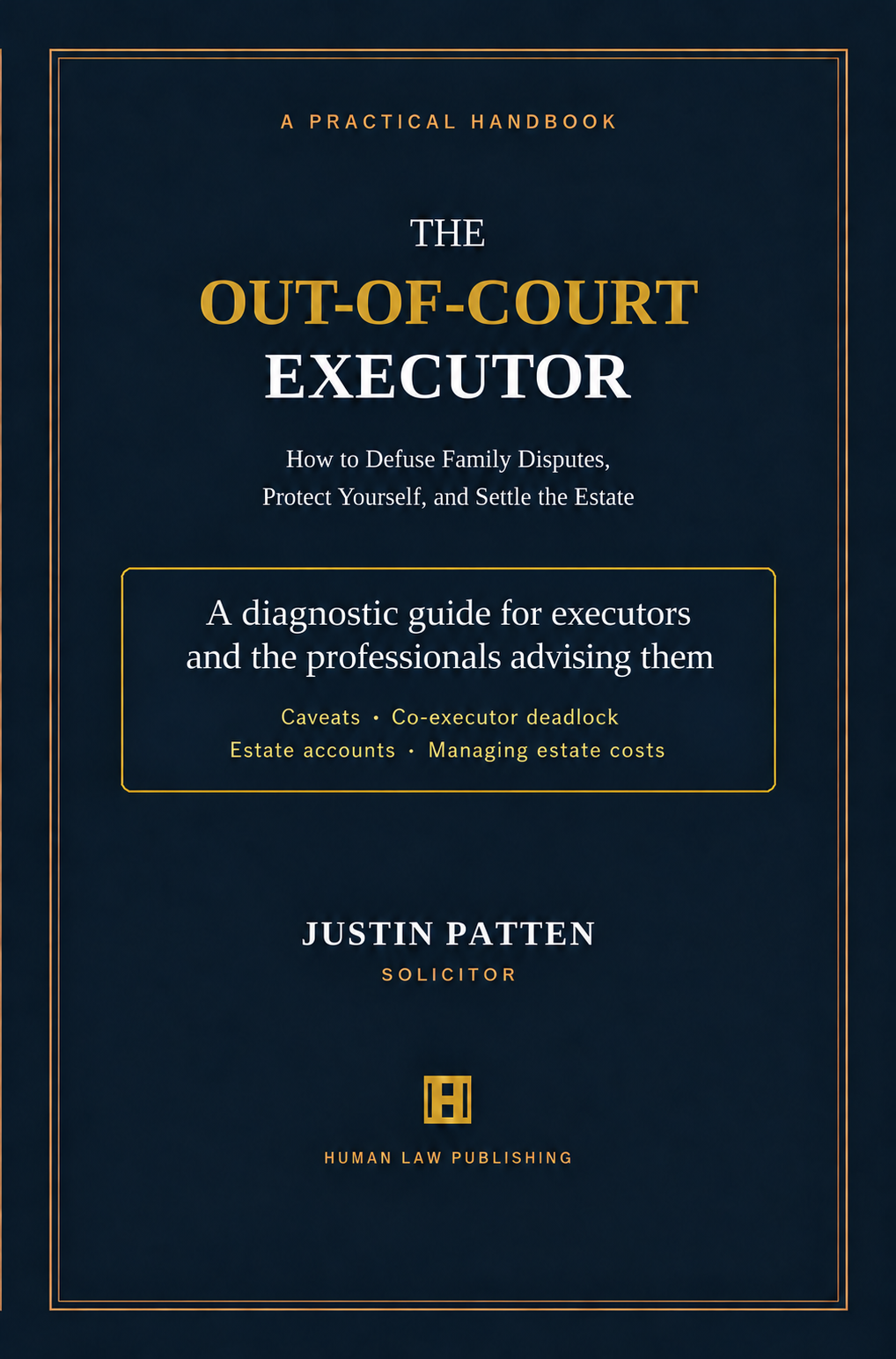
The Out-of-Court Executor
An estate is stuck. Family tensions are rising. The costs keep running. What should happen next?
A caveat blocks probate. A co-executor will not cooperate. Beneficiaries want answers about the accounts. For the person responsible for the estate, it can be difficult to distinguish a problem that needs practical action from one that requires a court decision.
Written by solicitor Justin Patten, drawing on more than 20 years’ experience in dispute resolution and private-client practice, this concise handbook helps executors, administrators and the professionals advising them understand the blockage and assess the available options.
Featured in Today’s Wills & Probate. Coverage of the publication of The Out-of-Court Executor and its practical approach to probate disputes and estate deadlock. Read the coverage →
Available now. See Amazon for current formats, prices and delivery options. See what is inside ↓
The Six Pillars diagnostic approach
At its heart is the Six Pillars diagnostic framework: a structured way to identify what is blocking the estate, assess the evidence and procedural position, and choose a proportionate next step.
It brings together evidence, procedure, rights, economics, behaviour and resolution, helping readers understand how the issues connect before deciding what to do.
Justin uses this framework in Human Law’s Dispute Assessment & Action Plan to identify the agreed principal blockage and recommend a proportionate next intervention. In co-executor disputes, separately agreed work may then include a focused solicitor’s proposal, negotiation or mediation preparation, with a defined fee and endpoint. You can contact Justin directly to discuss the appropriate starting point.
What the handbook helps you do
- Navigate caveats, Warnings, citations and defined Probate Registry procedures.
- Separate evidence from allegations and identify missing information.
- Make the estate’s financial position and continuing costs visible.
- Understand executor neutrality and personal costs exposure.
- Assess negotiation, mediation and when specialist legal help is needed.
The emphasis is on informed decisions and proportionate action, recognising that some disputes require formal legal proceedings or judicial determination. Probate Registry applications are themselves legal proceedings; they do not necessarily involve an attended hearing or substantive probate trial.
Explore the book
Browse the contents or read a complete chapter before deciding whether the handbook is right for you.
View the full contents
PREFACE
INTRODUCTION
PART 1: UNDERSTANDING PROBATE FRICTION
- Chapter 1: Understanding and Resolving Probate Friction
- Chapter 2: The Executor’s Concern Curve
- Chapter 3: Distinguishing Administration from Litigation
PART 2: THE DIAGNOSTIC TOOLKIT
- Chapter 4: The Six Pillars
- Chapter 5: The Caveat Pathway
- Chapter 6: Beyond the Caveat
PART 3: RESOLUTION STRATEGY
- Chapter 7: Executor Negotiation
- Chapter 8: The Limits and Uses of Advocacy
PART 4: MASTERY AND CERTAINTY
- Chapter 9: Predictability in Estate Disputes
- Chapter 10: Using Artificial Intelligence Responsibly
- Chapter 11: Becoming the Out-of-Court Executor
Appendix A: Statutory Clocks & Timers Table
Appendix B: Diagnostic FAQs: Quick Concern Check
Appendix C: Mediation & ADR Diagnostic Filter
Appendix D1: Monthly Carrying-Cost Ledger
Appendix D2: Estate Position at a Glance
Appendix E: Caveat Activity and Contentious Caseloads
Appendix F: Principal Legislation and Procedural Rules
Appendix G: Specialist Referral Handover Checklist
Appendix H: Case References and Notes
Glossary of Probate Terms
Read Chapter 2: The Executor’s Concern Curve
Why can estate administration feel so threatening before a formal claim exists? This chapter explores executor responsibilities, correspondence, family pressure and the continuing cost of delay.
Free to read. No email address required.
Practical tools alongside the handbook
Worksheets, online tools and guidance on responsible AI use support the diagnostic approach. The tools help organise information and inform discussion; they do not replace individual legal advice or formal estate accounts.
Understand the estate
Record assets, accessible cash and outstanding bills in the Estate Position at a Glance worksheet.
Make delay costs visible
Use the carrying-cost calculator to show how continuing expenditure changes with the timetable.
Prepare the next step
Organise the blockage and missing information with the Deadlock Information Builder, or assess readiness with the ADR Preparation Questionnaire.
Publication details
| Author | Justin Patten, Solicitor |
|---|---|
| Publisher | Human Law Publishing |
| Publication date | 19 October 2026 |
| Availability | Available now on Amazon. See the listing for current formats and prices. |
| Jurisdiction | England and Wales |
A practical diagnostic guide for executors, administrators and the professionals advising them.
About Justin Patten
Justin Patten is a practising solicitor with more than 20 years’ experience in dispute resolution and private-client practice. He is the principal of Human Law, providing solicitor-led advice, out-of-court resolution and defined Probate Registry procedures.
He is also the author of A Practical Guide to Elderly Law (2nd Edition) and A Practical Guide to Elderly Fraud, published by Law Brief Publishing.